Why Brick Walls Use More Than One Bond
Why brick walls use more than one bond: see how pattern, construction needs and appearance shape brickwork, while learning what a façade cannot confirm.
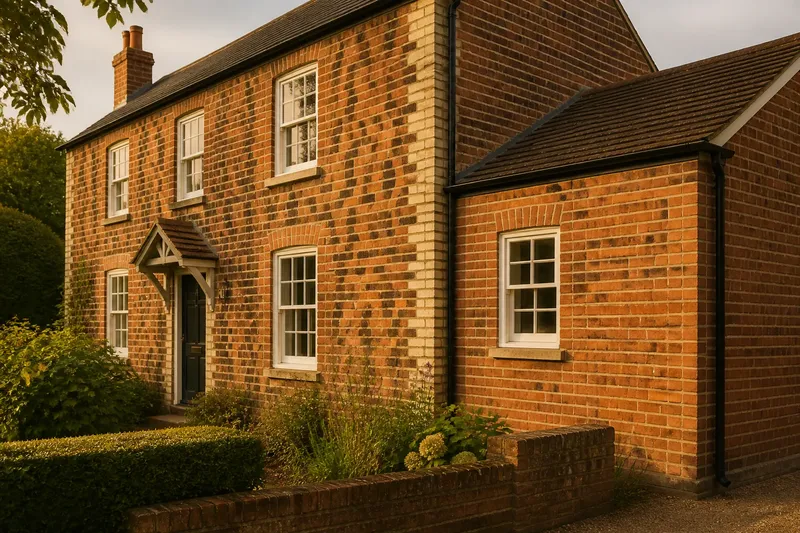
The common mistake when reading a brick wall is to treat its visible pattern as a complete record of how it was built. That can lead to a confident but mistaken description in a survey note, or to assumptions about the wall’s thickness and inner construction that a façade cannot support. Brick bonds are useful evidence, but they describe an arrangement at the face, not every course behind it.
Brick walls use more than one bond because builders balance how bricks are arranged, how parts of the masonry relate to one another, and the appearance wanted for the elevation. A plain stretcher pattern, alternating bands of headers and stretchers, and a more interlaced face each serve different visual and construction contexts. The pattern can suggest how a wall was laid, but it cannot settle the full build-up by itself.
What bonds do
A brick bond is the pattern formed by laying bricks in courses, with each brick positioned in relation to those around it. A stretcher is the long face of a brick; a header is its short end. From a normal viewing position, the visible combination of stretchers, headers and mortar joints gives a wall its characteristic rhythm.
Bonding helps arrange joints across the face and, in some forms of construction, can connect parts of a walling system. The choice also affects the look of an elevation: courses of long faces create horizontal lines, while visible headers introduce a contrasting beat. The right pattern depends on the wall’s design and construction, rather than on a single rule that applies to every building.
The visible bond is only one part of the evidence. Brickwork may include concealed components, a separate inner leaf, a cavity, ties or later alterations that cannot be read directly from the pattern. Think of the façade like the cover of a book: it offers clues about what is inside, but it does not show every page.
Stretcher bond
In stretcher bond, the long faces of the bricks are visible across successive courses, and the vertical joints are staggered. The amount of offset can vary with the layout and the work; it should not be assumed to be a fixed half-brick. The repeated horizontal lines give the wall a relatively plain, orderly appearance.
This pattern is common on modern brick façades and can be used where the visible face is a single thickness of brickwork. It is also found as the outer face of cavity walls, where a separate inner leaf forms part of the construction. Those arrangements can look similar from outside, which is one reason the bond alone cannot establish what lies behind the face.
For a survey description, stretcher bond can be a useful way to catalogue a broad, plain elevation. It is less useful as a stand-alone clue to wall construction. Record the visible pattern, then note any uncertainty about the internal build-up rather than inferring it from the regularity of the brickwork.
English bond
English bond alternates a course of headers with a course of stretchers, producing clear horizontal bands. At corners and returns, the layout may use specially cut or shaped bricks to maintain the pattern.
Headers across the face can suggest that bricks are arranged to connect across the wall’s thickness. In some traditional solid brick walls, headers perform that role. But a header-shaped face may be a facing brick or part of a more complex arrangement, so it does not prove that a brick runs through the full thickness.
This bond may be chosen for its strong banded appearance and for the way its courses are arranged in traditional masonry. Repairs or later changes can interrupt the pattern, and the visible face still needs to be considered alongside other evidence before describing the construction behind it.
Flemish bond
Flemish bond alternates headers and stretchers within each course, giving the face a repeating, interlaced appearance. Compared with English bond, where the two types of face appear in separate courses, Flemish bond distributes the alternation along each band.
The pattern can provide a more varied façade and is often encountered on traditional brickwork. As with English bond, its appearance may reflect choices about the masonry’s layout and finish, but it cannot independently confirm the wall’s thickness or inner construction. Weathering, repointing and replacement bricks can also make the original pattern difficult to read.
Questions about bonds?
Which bond is easiest to identify?
Stretcher bond is usually the quickest to recognise because the visible faces are predominantly long and the vertical joints are staggered. English bond alternates header and stretcher courses, while Flemish bond alternates them within each course.
Do headers prove a solid wall?
No. Headers can form part of a traditional arrangement that connects masonry across a wall, but a header-shaped face brick may not extend through the full thickness. Treat the feature as a clue and look for corroborating evidence, such as exposed returns or reliable building records.
Can one building use several bonds?
Yes. Different elevations, extensions, chimney breasts, boundary walls or repaired sections may show different patterns. A change can reflect a separate building phase or a design choice, but the bond alone does not establish when or why it occurred.
What should a survey note say?
Record the visible arrangement, its location and any interruption or uncertainty. For example, “Flemish bond visible on the principal elevation; local replacement brickwork at lower corner” describes what can be seen without claiming a wall thickness based on the face alone.
Reading the evidence
Start with the overall pattern, then inspect a clear area where individual bricks and joints are easy to distinguish. Note whether the faces are mainly stretchers, whether headers form separate courses or alternate within each course, and whether the pattern changes around openings, corners or repairs.
Next, look for places where the wall turns or is exposed. A return at a doorway, an existing opening with an exposed edge, or a visible junction may offer more information about thickness and build-up than an uninterrupted façade. Do not assume that an apparent feature is original: patching, replacement bricks and later coatings can disguise the earlier arrangement.
Say you are inspecting a house with a clear Flemish pattern on its front wall and a plain stretcher pattern on a side extension. You record each pattern and its location, then note that the elevations differ. The resulting description identifies the visible change without claiming that the bond alone dates the extension or reveals the front wall’s inner construction.
If a firm conclusion about construction matters, consult dependable documentation or arrange an appropriate further investigation rather than relying on the face pattern. Where interpretation has significant consequences, ask a qualified building professional to assess the evidence. A visual survey has limits, and stating them is part of a sound description.
Matching pattern to purpose
For a quick exterior description, identify the visible bond and where it occurs; stretcher bond may be enough to characterise a plain elevation. For a traditional façade, distinguishing English from Flemish bond can add useful detail to an architectural description or condition record.
Brick walls use more than one bond to suit different arrangements and appearances, but no pattern gives a complete account of what sits behind the visible face. Name what you can see, consider what it may suggest, and let the available evidence set the limits of the conclusion.