A Stain, a Tide Mark or a Shadow? Reading Wall Discolouration
Wall discolouration can point to useful clues, but not a diagnosis. Learn how to distinguish stains, tide marks and shadows and decide what deserves follow-up.
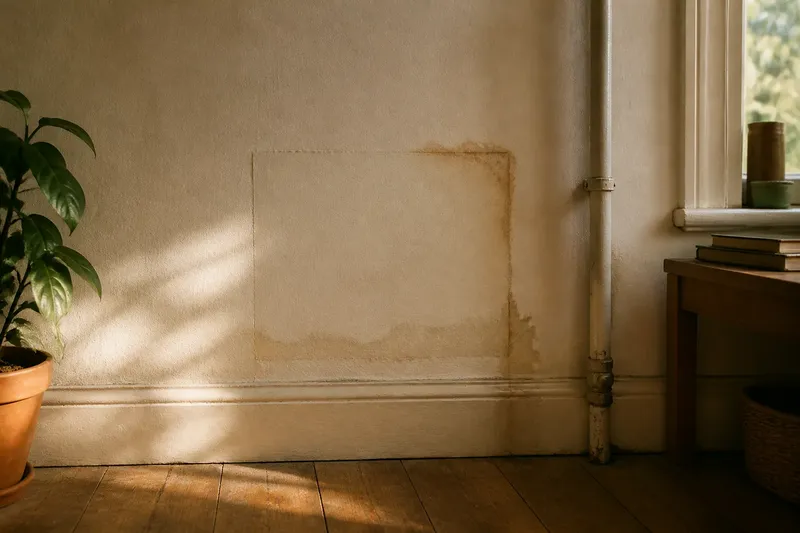
The common mistake with wall discolouration is to treat every dark patch as a moisture problem and every pale rectangle as an old repair. A wrong label can prompt the wrong maintenance response, while a simple change in paint or reflected light goes unnoticed. The useful question is not “What is this mark?” but “What does this surface actually show?”
Discolouration is a change in appearance, not a material diagnosis. A stain, tide mark and shadow can overlap, but their different boundaries and surface effects help you decide what to examine next. That distinction matters because a visual inspection cannot reveal what is concealed behind plaster, wallpaper or a coating.
Surface and light
Start by considering how the finish behaves. Gloss paint reflects light differently from matt paint; wallpaper adds a pattern and texture; bare brick and plaster absorb and scatter light in their own ways. A patch that seems to move or fade as you change position may be a shadow or a difference in sheen rather than a change in the wall itself.
Look across the surface from several angles, without scraping, peeling or probing it. A shadow may have a crisp boundary that changes with the light source. A material or finish change tends to remain in the same place, though its apparent colour can still shift as the light changes.
For an unfamiliar mark, note the finish, the kind of light, and whether the boundary stays put when you move. Those details help separate an effect of illumination from a change that is fixed to the surface.
Stains and trails
A stain is a visible area of altered colour. It may be diffuse, sharply edged, or shaped like a trail, but none of those appearances identifies its source. Brown or yellow staining can accompany water, yet colour alone cannot establish whether wetting is current, historic or unrelated to a leak.
Pay attention to where a trail appears to begin and end. A narrow mark below a ceiling joint or near a pipe is a reason to note that relationship, not to assume the joint or pipe caused it. Finishes can carry marks beyond their point of origin, and repairs may alter the pattern.
Say you see an invented, hypothetical example: a yellow-brown patch sits below a bathroom pipe, with a faint trail reaching towards the ceiling. You note that the plaster is painted, the trail has a soft edge, and the patch appears unchanged from the doorway to the side of the room; you do not touch or open the finish. The resulting note identifies a location and visible pattern for a maintenance professional to assess, while leaving the source unresolved.
Tide marks and deposits
A tide mark often looks like a band, sometimes with a darker line at its edge. Describe whether it runs along one wall, turns a corner, or stops at an opening, and whether the surface above and below looks different. A familiar band is not proof of rising damp: leaks, splashing, salts, historic wetting and changes in materials may also need consideration.
White or pale deposits can appear on masonry and other surfaces. Their presence does not establish why they formed or whether the wall is currently wet. Avoid brushing, tasting or disturbing unknown deposits; a qualified building professional can assess them in context if they affect repair decisions.
A tide mark is a little like the ring left inside a cup: it shows where a visible boundary formed, not the full history of what reached it. The outline is a clue, not a record of cause or timing.
What should you check?
Does a tide mark prove rising damp?
No. It is a visible band, while the cause depends on the building and surrounding evidence. Describe its position and continuity, then seek a suitable assessment before choosing a remedy.
Can colour identify a leak?
No single colour reliably identifies a leak. A brown patch can be associated with water, but appearance alone cannot say whether it is active, old or unrelated to a leak.
How can I tell a shadow from a stain?
Change your viewing position and notice whether the mark changes with the light. A shadow may shift or fade, while a surface mark tends to stay in place; this comparison is helpful but not conclusive.
What should I do if the surface feels damp?
Record how you noticed it and avoid treating touch as a full assessment. Do not disturb damaged or suspect material; if the concern may affect health or safety, ask a qualified professional for advice.
Choosing what happens next
Use the visible pattern to decide whether the next action is simply to keep a note, compare an authorised later view, or ask for professional advice. These checks keep the focus on observable results rather than a guessed diagnosis:
- If the mark changes or fades as you move around the room, then check it under another ordinary viewing angle; if it stays fixed, describe it as a surface mark and continue to the next observation.
- If the edge is sharp and follows a neat rectangle, then compare its finish with the surrounding wall; if the paint or texture differs, record a likely finish boundary without claiming what used to be there, and if it does not differ, note the unexplained shape for assessment.
- If a trail meets a visible pipe or fitting, then record the exact relationship without assigning blame; if no fitting is nearby, describe the trail’s direction and nearest junction instead.
- If a band continues along the wall or turns a corner, then note its continuity and the surfaces above and below; if it stops abruptly, record the stopping point and nearby opening or material change.
- If peeling, bubbling or powdery material accompanies the discolouration, then avoid disturbing it and seek suitable advice if repair decisions depend on it; if the finish remains intact, describe that condition and keep the cause open.
- If a maintenance record mentions a repair or replaced fitting in the same area, then note its date and source alongside the current observation; if there is no relevant record, do not infer a past event from the mark’s shape.
Imagine an invented, hypothetical situation: a tenant notices a pale rectangle above the skirting board and a faint brown mark at one corner. They record that the wall is matt-painted plaster, the rectangle has a crisp edge, and a visible pipe runs nearby; they also note that the brown mark looks soft-edged and do not touch the surface. A maintenance note mentions earlier decorating but says nothing about the pipe. The resulting account supports a follow-up that considers both the finish boundary and the nearby fitting, without treating either as the cause.
Keep the limits clear
A visual inspection can describe accessible surfaces and identify changes that may deserve attention. It cannot establish what lies behind a finish, where moisture began, whether a concealed service is involved, or whether a mark is active. If the answer affects repair work or safety, consult a suitably qualified building professional rather than choosing a treatment from appearance alone.
For wall discolouration, the most useful outcome is a clear distinction between a lighting effect, a surface change and an unresolved pattern. Once that distinction is recorded, a surveyor or maintenance team can decide whether further inspection is needed without mistaking a striking outline for a complete explanation.