A Quiet Walk Through a Building: An Observation Routine
A building observation routine turns a familiar walk into a useful maintenance record, helping you spot what needs follow-up without guessing at causes.
The common mistake in a building observation routine is to decide what a change means before deciding who needs to act on it. That can send a maintenance request down the wrong path, while the useful distinction—routine upkeep, a record gap or a concern needing assessment—gets lost.
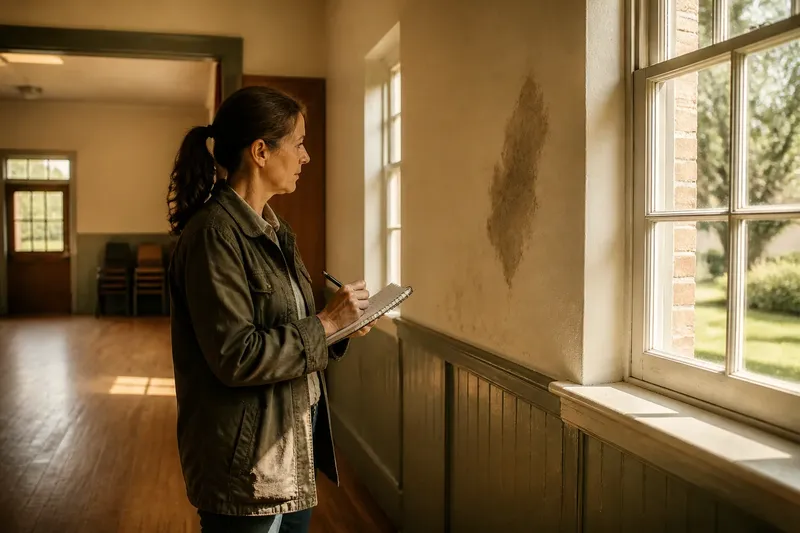
Imagine you manage a small community hall and notice a dark patch beside a window. Rather than treating the walk as a hunt for defects, use it to route visible observations sensibly: log ordinary changes, connect them to existing records where appropriate, and pass concerns to someone qualified when visual evidence is not enough.
Walk with a purpose
Choose a familiar route through accessible spaces, such as the entrance, main room, corridor and kitchen. A steady route helps you cover the building without turning an informal observation into a survey. Stay on ordinary walking surfaces, and do not enter restricted or visibly unsafe areas.
Take a notebook, a phone or the building’s existing log. Use a room list or floor plan to identify locations, not to infer what lies behind a wall or ceiling. Do not climb, open panels, lift coverings or move stored items; the routine concerns visible fabric from a safe, ordinary position.
Sort the next action
A useful record answers a practical question: should this be left for routine monitoring, matched to a maintenance record, or referred for assessment? Describe what is visible before choosing a route, and keep the observation separate from any explanation of its cause.
- Check the location. If the room and surface match an existing work order, link the note to it; if they do not, record the location independently and ask the building contact to clarify the record.
- Check for a prior entry. If an earlier note clearly identifies the same feature, compare the wording and appearance; if the location or view differs, treat it as a new observation rather than claiming a change.
- Check access and visibility. If the whole feature is visible from a normal position, describe it directly; if furniture, stored items or restricted access obscure it, record that limit and do not move anything to get a better view.
- Check whether the record supports comparison. If an earlier image shows the same area in a recognisable view, note whether the appearance seems unchanged or different; if lighting or framing prevents a fair comparison, state that and avoid a conclusion.
- Check whether the matter belongs in routine upkeep. If the observation is a straightforward visible item already covered by an authorised maintenance process, pass it through that process; if the cause or significance is uncertain, request assessment rather than specifying a repair.
- Check for an apparent immediate hazard. If the area appears unsafe, keep clear and use the building’s established urgent reporting route; if there is no apparent immediate danger but concern remains, notify the responsible person for appropriate review.
Keep notes useful
Give the observation a date, a room and a fixed landmark. “Main hall, north wall, to the right of the window facing the entrance” is easier to match than “near the window”. Use familiar room names consistently, and retain an older label if maintenance records use a different one.
Describe appearance in ordinary language: a narrow line, a dull patch, chipped paint, a gap at a trim edge, or a door that appears out of square in its frame. Avoid causal labels such as “leak” or “movement” unless a qualified person has established them. The note is a handover, not a verdict.
Say you are updating the hall log and see the patch beside the east window. You enter the date, location and description “uneven dark patch on painted wall”; an old work order names the west window, so you do not attach the new note to it. You send the observation to the building contact for a location check, leaving the cause and any repair decision open.
Use records carefully
Keep each note with any supporting image or relevant maintenance entry. A photograph can help identify a place, but a close view without surrounding context may be hard to match later—like a spare key with no label. Take images only from a safe position, preserve the original, and note if the view is partly obscured.
When records use inconsistent room names, retain both names and explain their relationship only if it is clear. A past repair in a nearby area is not, by itself, evidence that a new visible feature has the same cause. If the record is ambiguous, ask the person responsible for maintenance to resolve the link.
When should someone else decide?
What belongs in a maintenance log?
Record the date, precise location, visible feature and any limit on access or visibility. If there is a related work order, include its reference only when the location and subject clearly match.
Should I request a repair?
Use the established maintenance process for an item whose remedy is already clear and authorised. If the cause, extent or suitable response is uncertain, report the observation and ask for assessment rather than prescribing work.
What if I cannot compare two visits?
State why the comparison is unreliable, such as a changed viewpoint, different lighting or an obstruction. Keep both records without claiming that the feature has changed or stayed the same.
When is a visual routine not enough?
A walk cannot assess concealed building fabric or establish the cause, extent or safety implications of a concern. Follow the building’s reporting process and seek a qualified professional’s judgement where the matter calls for it.
Make the handover count
A building observation routine is most useful when it ends with a clear next owner, not a confident guess. Leave the note easy to trace, identify any uncertainty plainly, and let the responsible maintenance contact or qualified professional decide what the visible evidence warrants.